

This article is written strictly from my own personal point of view and my experiences will probably differ quite significantly from those of other people who hail from different backgrounds, utilise different approaches to studying or are actually just much smarter than myself.
One of my biggest regrets from the time I previously spent living in China was that I failed to adopt an adequate approach or attitude towards learning to speak the local language (or at least ‘Standard’ Mandarin) at the very beginning. To put it quite simply, I was far too laid-back and casual about it and thought that a token few phrases spoken badly would always be enough to get by. Later, I did a lot to rectify such mistakes, yet if I had my time again, I would definitely do things very differently.
When I arrived in Vietnam in December; I had already decided prior to my move that I would find a way to learn to learn the language formally, rather than rely solely upon the token few phrases included in a Lonely Planet guidebook and their strange and weird attempts to display the correct pronunciation. I would not deny that I have already faced a lot of challenges and will continue to do so, but this is what I have found so far:
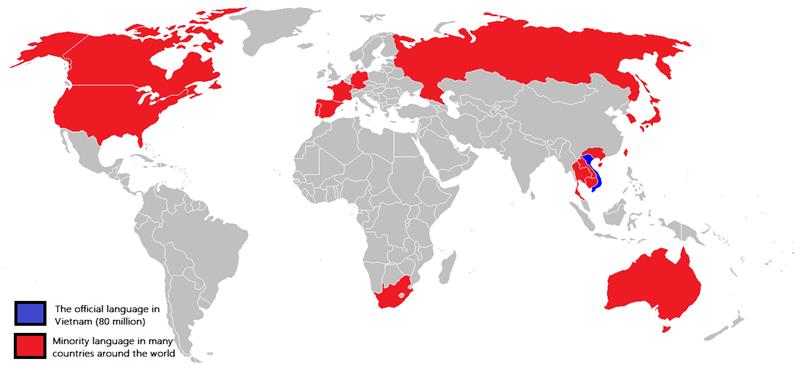 Image Source: alotrip.com
Outside of Vietnam, it’s not really a popular language:
When you study a European language at high school in the West, you can be sure that you’ll be able to get hold of tonnes of learning materials. That’s because most of these languages have widespread appeal that goes far beyond usage in their countries of origin. France, Spanish and Portuguese are the official, natively spoken languages of various nations in Africa and South America. Russian is also used in many an ex-Soviet nation.
Other Asian languages may have widespread appeal because of their cultural influence or the hype around them in the media. Japanese is always going to attract the anime crowd, even if those learning it never get the opportunity to visit Japan. Mandarin Chinese is gaining in popularity as China becomes more influential on the world stage, people even want their 5 year old kids to start learning it while they are still barely able to speak their own native language.
Vietnamese however, probably appeals either mainly to Overseas Vietnamese people that failed to learn the language at home with their parents or those people that actually want to live and work in Vietnam. Unfortunately this means that it isn’t always easy to find good learning materials, online duo-lingual dictionaries or apps to help you learn Vietnamese, whereas when it comes to Mandarin these days, you’re probably spoilt for choice.
Still, it should be remembered that Vietnam is the 15th most populated country in the world. Therefore, if one does successfully learn the language; they will probably have little difficulty in finding people to talk to.

Image Source: pinterest – original website now defunct.
The romanisation system:
A lot of foreigners like to believe that Vietnamese is easier to learn to read and speak than Mandarin or Japanese thanks to the fact that it uses a Latin alphabet that is familiar to those who speak English, French, German or even Finnish. This erroneous belief lies in the fact that non-native speakers will not need to learn to recognise thousands of characters, but will instantly recognise most of the letters straight out of the box. That sense of familiarity lulls them into a false sense of security.
However, even compared to the romanisation systems of ‘Romaji’ used in Japanese and ‘Pinyin’ for Mandarin, the Vietnamese alphabet script known as ‘chữ quốc ngữ’ does not correspond well with the sounds that an native English speaker would expect to hear. Personally, I have also faced additional difficulties due to being accustomed to speaking Mandarin; which seems to lead me to occasionally mispronounce the letter ‘c’ with the ‘ts’ sound; much to the amusement of my Vietnamese teacher.
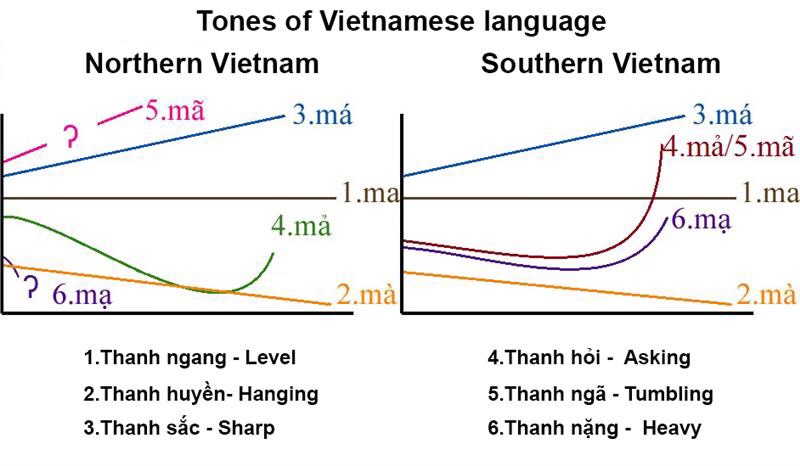
Image Source: alotrip.com
The tones:
Most other foreigners tend to state that the hardest part about learning Vietnamese is the 6 tones. Rather controversially perhaps, I’m going to say that is not the case.
For me, it has been nowhere near as difficult for me to get used to the tones as when I first started speaking Mandarin. The 6 tones of Vietnamese seem very similar to those of Cantonese to me and while those additional 2 tones compared to the 4 of Mandarin intimidated me at first; one may feel that a good teacher can help you to get past this initial hurdle or at least, identify and correct your errors.
Sure, you’re going to make mistakes now and then. I still make mistakes when speaking Mandarin half of the time. Vietnamese however, actually illustrates those tone-marks on the words themselves (a,à,á,ả,ã,ạ), removing the need to focus upon memorising the tones used for the correct pronunciation of individual characters. When you read from that textbook, they’re literally laid out in front of you.
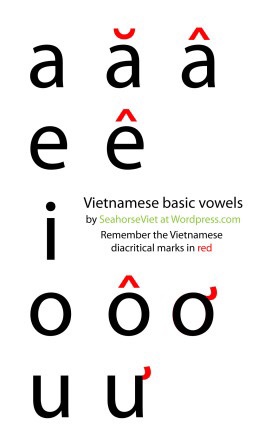
Image source: seahorseviet.wordpress.com
Additional vowel (and consonant) sounds:
This actually causes me much more difficulty than the tones. Having to adjust to using additional vowel sounds/letters is something that can throw me a little off-balance and the examples that I shall provide do not represent an exhaustive list.
It is often the case that I will forget the difference between an ‘o,’ an ‘ô’ and an ‘ơ.’ The ‘ơ’ and the ‘ư’ are particularly troublesome for me as I may often fail to spot that little additional stroke that differentiates them from an ‘o’ and a ‘u.’ Not to mention that ‘d’ and the ‘đ’ pairing. Although just one stroke apart on paper, those initials can seem a world apart for me; especially when I hear them being spoken by a native-speaker.

Image Source: easyamericanenglish.blogspot.com
Nice local people not letting you practice with them:
Most Vietnamese people according to my experiences so far, are good, nice people. However, the overall level of spoken English in the urban centres of this country is pretty high and those that can speak English, will try to make your life easier by speaking a little English to you or even providing you with English menus. If you have local friends, some may relish the opportunity to practice speaking English too.
Although, I should be grateful for the effort that is often made at restaurants and cafes to accommodate a confused, lost foreigner such as myself; efforts made to speak English can sometimes deny me the chance to do something as simple as trying to order something in Vietnamese. This may relate to the fact that I live in a very developed city that is rather popular with tourists and I am yet to visit the more rural parts of the wider local area.
Northern/Southern differences:
This is probably not something that I should complain about too much yet. Đà Nẵng being rather central appears to tolerate words from both sides of the national linguistic divide, but it is not always a 50/50 split.
I may use a textbook written in Hà Nội, but am often informed by my teacher that locally, I may be better off using the Southern variation of a word to better allow myself to be understood. Hà Nội may be the nation’s capital and one may assume that the accents or dialect spoken there represent the standard that all should aim towards. However, some long residing foreigners have told me that the dialects commonly used in Sài Gòn are much easier for foreigners to learn.
Concluding remarks:
In a few months time, I hope that I will be able to write a follow up piece which involves myself looking back and laughing at how one could possibly perceive such minor issues to represent genuine challenges on the path to learning the Vietnamese language. If you think this piece is full of erroneous and misinformed claims; that’s because it probably is, we were all newbies once.
Any Vietnamese people reading this article may struggle to understand why I consider the language to be fairly difficult for a foreigner to learn; or could point out that my understanding of the actual nature of their language is not correct. If any local people can provide me with any good advice or assistance to help me to improve, I would greatly appreciate it; but please be gentle.
Linguistic experts or language teachers could easily criticise me for failing to use correct and proper linguistic terminology when describing the challenges that I faced; I shall kindly remind them that this language is not really targeted towards them. This is really aimed that those who have considered learning Vietnamese, but aren’t really sure what to expect. While their own experiences may be entirely different to mine, I do think it would be nice to share our stories about it.


 Đà Nẵng Diaries